
Your Agent Bought a Ticket. Who Authorised It?
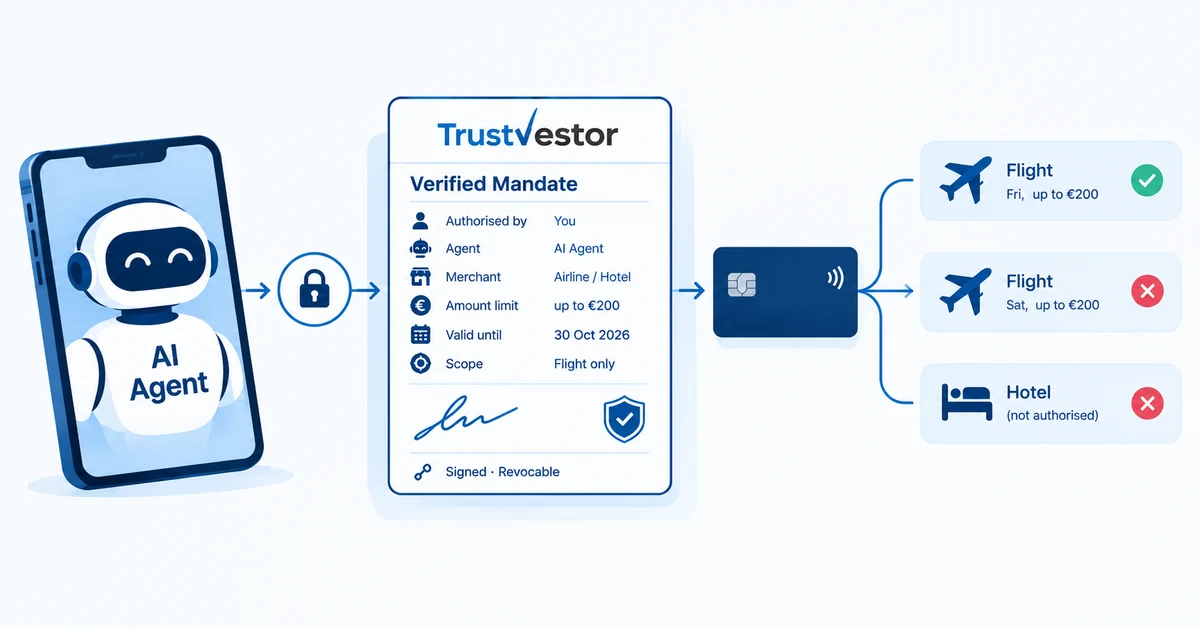
You tell your AI assistant: “A flight to Vienna on Friday, up to €200.” In the morning, you find two flights, one for Friday and one for Saturday, plus a hotel you never asked for. All charged to your card.
Until a few months ago, this was hypothetical. Since July 2026, it is real. Visa announced that with over 30 European banks, AI agents now select products and pay on your behalf. The list includes Barclays, BBVA, ING, Commerzbank and Revolut.
Visa answered two questions.
First: is the agent real? That is what Trusted Agent Protocol does. It shows the merchant that they are dealing with a verified AI agent, not a data-scraping bot.
Second: did the user confirm? That is what Payment Passkeys do. Digital keys that let the user confirm the payment without a password.
Both steps matter. But the second one is technical, not legal. The parameter in the app is a limit. It is not a mandate.
What the law says
Bulgaria’s Obligations and Contracts Act has dealt with this situation for decades. Article 42 covers a person who acted as a representative without authority. Such a contract does not bind the principal until they ratify it. The rule is clear when the representative is a human.
The agent is not a human. In my view, an AI agent cannot be a representative under the law because it has no legal personality. The question then is whether its actions are our own declaration of will, made through a tool, or something else.
If it is the former, we lose the protection of Article 42. We cannot refuse to ratify something that the law treats as our own act from the outset.
What payment services rules say
The Payment Services and Payment Systems Act looks for something else: whether the payer consented. A payment operation without consent is unauthorised. The provider must prove the operation is authentic. If it cannot, it must refund the amount by the end of the next business day. In case of gross negligence by the payer, the loss is theirs.
This is where the problem lies. The second ticket and the hotel are confirmed with your digital key. The bank will say there is consent. You will say you consented to one flight up to €200. The merchant will say the agent was verified. All three will be right until someone shows what exactly you authorised.
This raises the question banks will sooner or later ask: is it gross negligence to give your card access to an AI agent without clear boundaries?
A mandate a machine can read
The solution is not to stop agents. They are already paying. The solution is for every agent to carry a mandate that both a machine and a court can read. It must state who is authorising, what exactly, up to what amount and until when. The mandate must be signed so it cannot be tampered with, and it must be revocable with a single action.
European law already provides the language for this. Regulation (EU) 2024/1183, known as eIDAS 2.0, governs electronic attestations of attributes. Annex VI explicitly lists “powers and mandates to represent natural or legal persons”. A mandate as a signed, verifiable digital attribute is not science fiction. It is provided for in a regulation that is already in force.
Why this matters for business
If you sell in Europe, in my view within the next one to two years you will face payments initiated by AI agents. The question is how you will protect your transactions from chargebacks when the customer claims the agent exceeded the authorisation. And how you will prove you accepted a payment within a valid mandate, not just authentication.
If you are a bank or fintech, the questions are even sharper. Who bears responsibility when the agent acts outside the expected scope? And how will you comply with the requirements for authorised versus unauthorised payment operations when the instruction comes from AI?
The answer will not come from stronger authentication alone. It requires a new layer of trust. A layer of mandate, not just identity.
What Trustvestor does
At Trustvestor, we are building infrastructure that turns the instruction to an AI agent into a verifiable, signed mandate, linked to European digital identity standards. We leave an audit trail that can serve as evidence in a dispute between consumer, merchant and payment provider. The goal is simple: when the agent pays on your behalf, it must be possible to show unequivocally on what legal basis it did so.
If you want to discuss how this model could apply in your organisation, get in touch.
Andon LucienCEO, Trustvestor Ltd.This text is for informational purposes only and does not constitute legal advice.
This text is for informational purposes only and does not constitute legal advice.